Dermatology
Mole Mapping
Prevention and Monitoring of Skin Health
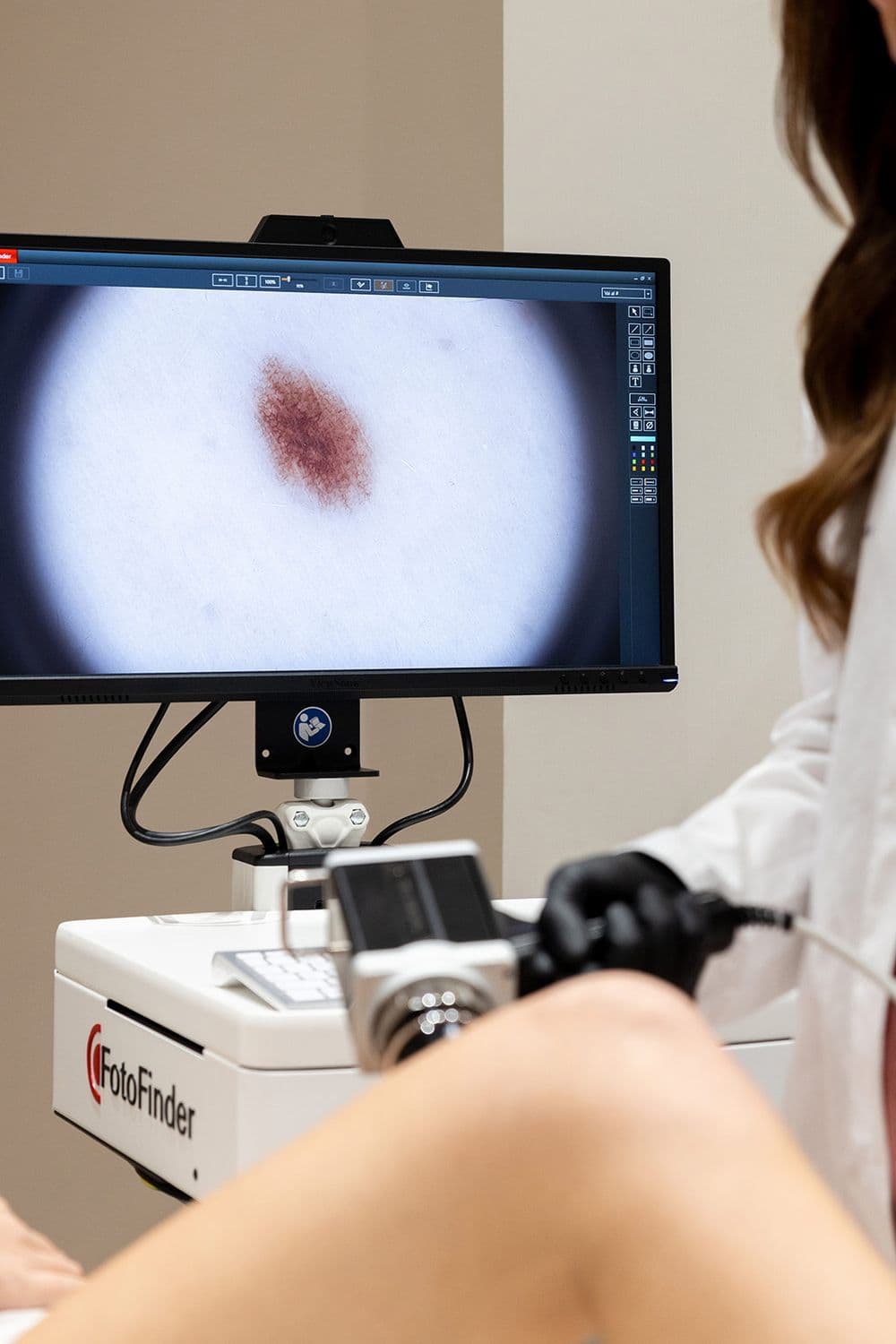
Mole mapping, which allows the identification and analysis of nevi, is an advanced dermatological examination that helps prevent melanoma and monitor pigmented skin lesions over time.
At Studio Aimi, thanks to digital dermoscopy with FotoFinder® Vexia technology, it is possible to observe skin details invisible to the naked eye and store images for continuous monitoring. Introduced in the 1990s, dermoscopy is now an essential tool in dermatological oncology, enabling early melanoma detection, diagnosing more cases than clinical examination alone, and reducing unnecessary surgical removal of benign nevi. This approach makes it possible to rapidly distinguish melanocytic lesions from non-melanocytic lesions, and identify benign lesions from those that are suspicious or malignant, in a non-invasive and painless way.
Digital image storage also allows moles to be compared over time and monitor any suspicious changes with precision.
Thanks to this approach, mole mapping is safe, painless and indicated both as a preventive examination and in the presence of numerous moles or family history of melanoma.
To book a dermatological consultation at our Studio in Parma, please fill in the dedicated form or contact us directly.
Mole mapping is an advanced dermatological examination that uses digital dermoscopy to observe and monitor moles over time, helping to prevent melanoma through the early detection of suspicious lesions.
Digital dermoscopy with FotoFinder® Vexia allows dermatologists to observe skin details invisible to the naked eye and archive images for future comparison, improving early diagnosis and reducing unnecessary surgical procedures.
No. The examination is completely non-invasive and painless, based on digital observation of moles without any surgical intervention.
It is recommended for individuals with numerous moles, family history with melanoma, fair phototype or irregular moles. It is ideal for those seeking comprehensive dermatological prevention.
The frequency varies depending on risk: generally once a year, while those at high risk can repeat it every 6 months.
A mole should be evaluated if it changes in shape, colour or size, if it bleeds, itches, or appears different from other moles. The appearance of new moles in adulthood should also be assessed.
Mole mapping is more thorough than a standard visit: it includes high-definition digital image recording, allowing moles to be monitored over time and detect even minor changes.
At Studio Aimi a Parma, with digital dermoscopy FotoFinder® Vexia, we guarantee precise and safe monitoring of moles, with image archiving for future comparison and continuous follow-up.
